Have GM Site PCBs Created Monsters?

Following up on rumours of heavy machinery operating along the Merritt Trail on the west side of the 2nd Welland Canal in Canal Valley, SubStandard reporters decided to investigate and get to the bottom of the matter.

They were shocked by what they discovered.

The intrepid reporters found tracks of what appeared to be a D9 Caterpillar tractor, and relying on their finely-honed tracking skills, followed the faint trail westward into the little-used Princess Park, where they came upon two pallets stacked high with bags of a white powder.

Pushing deeper into the dense woods, the reporters were startled to stumble on an unnamed creek flowing through enormous culverts underneath the 406 highway into the trackless swamp on the other side. The hillside above the culverts had been scraped clean of vegetation and a makeshift bridge spanned the creek. There was a porta-potty and Bobcat backhoe parked hidden in the brush. What was going on?

Suddenly the creek erupted. A mammoth green head shot above the water followed by a slithering scaled body that extended back through the culvert. Instantly grasping the danger they faced, one brave reporter tackled the emerging snake and wrestled it to the ground until it finally had enough and retreated back into the swamp on the other side of the highway.

At this point, we have no explanation. One theory is that the animal the reporters encountered was a green anaconda, known to have arrived in Florida some years ago and reportedly moving north. A more likely possibility is that the beast was a mutated northern water snake, common in the region. With high concentrations of  PCBs —  known to cause birth defects — flowing from the GM site into 12 Mile Creek, it is possible these snakes bred in the marsh below the site and slithered their way across Glenridge and the St Catharines Golf and Country Club and into the creek.

We do know that the devastating lamprey eel was first controlled in streams where the eels spawned by using electro-mechanical barriers called weirs. Is a giant version of the lamprey weir being constructed? The main control mechanism now is the dispersal of lampricides in spawning areas. Are those bags filled with Tri-Flouro-Methyl-Phenol (TFM), the most commonly used lampricide? Could this be a desperate effort to contain these mutants before they escape? 

Clearly, there are many questions yet to be answered.

Heritage Designation Curse Strikes Again!

Flames have resolved another troublesome heritage designation issue that City Council has been deliberating for over a year. On July 12, the 140-year-old Welland Hotel, a St. Catharine’s landmark, burned to the ground. At 8:00 that evening, while the remains of the old hotel were still smoldering, Council passed a resolution naming it a heritage site.

The blaze happened only months after another potential heritage designee, the GM smokestack, was knocked to smithereens by an errant backhoe.

“Accidents do happen,” the Mayor declared when approached for comment by the SubStandard. “While we’re sorry to see the old wreck of a building go, there are a couple of upsides.”

 One of the benefits is that the disappearance of the hotel removes an item from City Council’s busy agenda, he said. “What with the pandemic and all, we’ve got a lot on our plate. Now that it’s just a heritage basement, we don’t have to worry about what to do with it.”

The other benefit the Mayor pointed to is that the demise of the hotel, like the smokestack, benefits both property owners and potential real estate developers.

“Isn’t that what heritage is all about?” the Mayor asked. “Using the old to benefit the here and now? We have a forward-looking Council that quite correctly sees both past and present as needing to benefit the citizens of today. Losing the hotel building means gaining some profitable real estate for somebody.”

A spokesman for the city’s heritage committee, Moderna Bettor, speculated that the hotel’s demise was due to what she described as “the heritage designation curse.” She pointed to the old library, the 19th century Barnes and Whitman knife factory — now a world-class skateboard park — and YMCA building as also being destroyed while under consideration for heritage status.

She suggested that the work of heritage preservation could best be conducted moving forward by disbanding the heritage committee. That way no other buildings could be recommended for heritage designation to City Council, she pointed out.

“It’s the only way to end the curse,” she said. “Without potential heritage designations, tangible evidence of St. Catharine’s past will be successfully preserved. Unless of course those properties are needed for some other vital and important purpose, like parking lots. I mean, what good are heritage properties if you can’t park on them?”

School Board introduces Innovative Climate Change Program

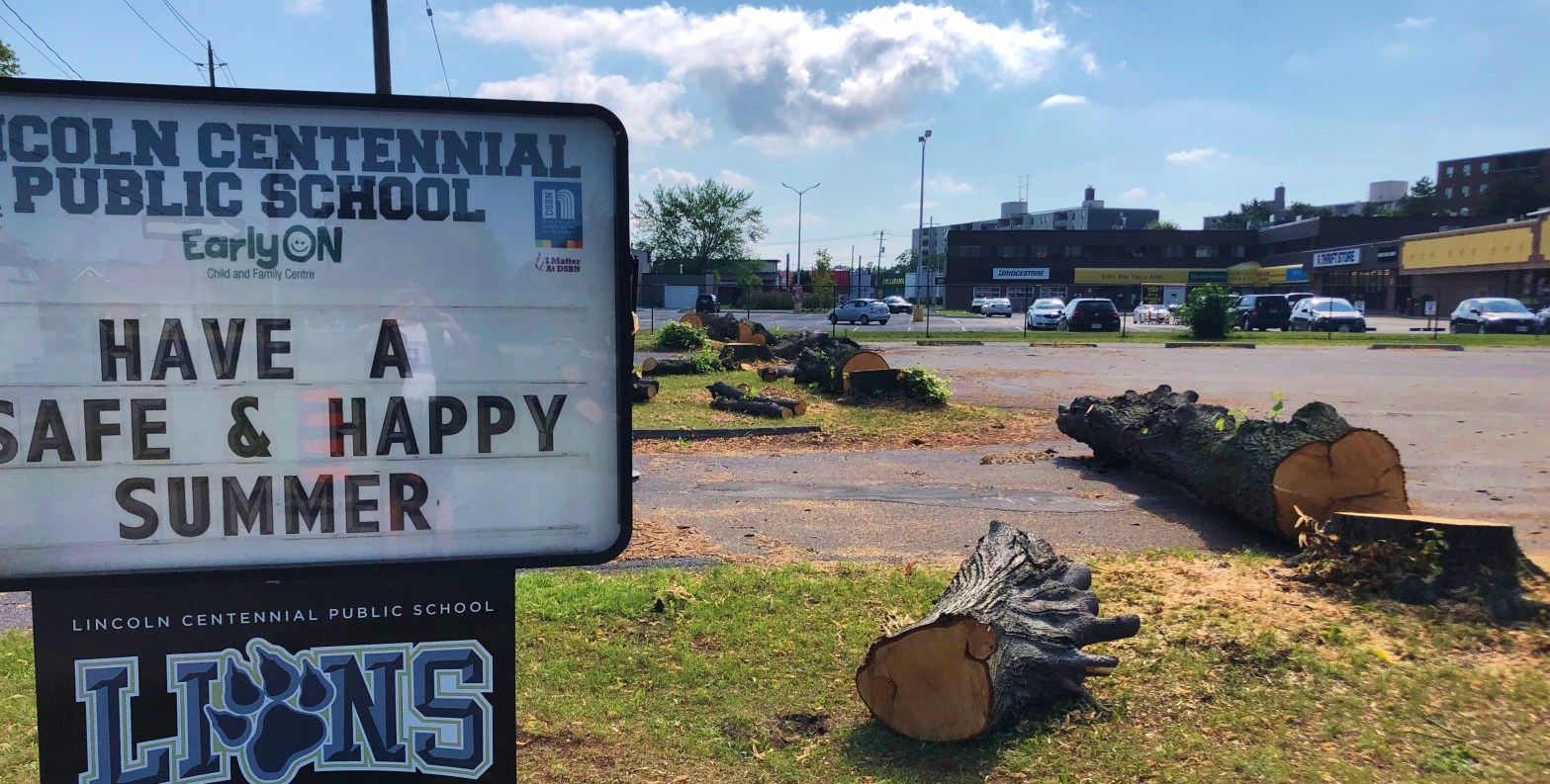
While many observers driving by Lincoln Centennial Public School have expressed shock and dismay at the massacre of about a dozen trees, some nearly 100 years old, along Scott Street, we are happy to report that this is in fact an element in a new curriculum unit designed to help students better understand the effects of climate change.

A spokesperson for the District School Board of Niagara (DSBN) explained that the idea is consistent with the pedagogical practice of “experiential learning.”

“We are in the midst of a global climate crisis,” Weldon Chute observed. “Did you know that just in the last 25 years we’ve lost 1.3 million square kilometers of the world’s forest?”

When a reporter for the SubStandard admitted he did not but that making this point by cutting down more trees seemed counterintuitive, Chute smiled slyly.

“Exactly! You see, we don’t just want kids to learn about deforestation, we want them to feel it. To feel the sun and UV rays burning their skin, we want them to feel the bleakness and devastation of a clear cut forest. We want them to sweat in the blazing heat where there used to be shade. Isn’t that cool?”

Chute went on to proudly explain how their decision to slaughter century trees is based on recent research in experiential learning. “Experiential education is a philosophy that informs many methodologies,” Chute enthused. “Educators purposefully engage with learners in direct experience and focused reflection in order to increase knowledge, develop skills, clarify values.”

When asked what values were being clarified if, as reported, the trees were cut to expand the faculty parking lot, Chute said Niagara schools are committed to preparing students for the real world. Kids, he said, need to learn how to cope with disappointment and economic realities. “And ultimately,” Chute said, “one of those realities is what good are trees if you can’t park on them?”

Meanwhile, SubStandard would like to inform its loyal readers that it is investigating rumours that the trees were actually cut for lumber to help offset the 2.4 million dollars embezzled by DSBN senior financial officers.

Parks Department Announces Magnetic Fishing Derby

If you get lemons, make lemonade. That was the spirit of the recent announcement by a spokesperson for Mayor Sendzik in announcing a new event for fishers, young and old.

“We are very excited about this,” the spokesperson said. “Fishing derbies are real popular family events and we have a chance to put one on right here in St Catharines that is unique and builds on our special assets. Martindale pond is absolutely loaded with heavy metals,” the mayor’s deputy went on. “We will be the first Magnetic Fishing Derby in the whole world!”  

When reporters covering the announcement opined that magnets would only attract iron and other ferrous metals, Director of Municipal Works, Darrell Smith, stepped in to set them straight. “That is a popular misconception,” he said. “In fact lead, manganese, cadmium, cobalt, mercury, nickel and a bunch of other stuff are all attracted to magnets. And we’ve sure got lots of that.” he enthused. “The fish are full of them!”

“I can tell you, with all the heavy metals we’ve got in 12 Mile Creek and Martindale Pond, kids will be pulling those toxic suckers out of the pond like nobody’s business.”

Full rules will be announced soon, but the SubStandard has learned that fishing gear will be limited to neodymium fishing magnets with no more than 375 lbs. pulling force, about the strength needed to pull a 24-inch common carp full of heavy metals or a submerged shopping cart out of the water. As well, the City spokesperson made clear that the tournament will be entirely catch and release. “They wouldn’t want to eat the fish they catch anyway,” he pointed out. “Not if they know what’s good for them.”

Participants will be required to sign a waiver at the time they register agreeing that the City cannot be held responsible for any abnormalities, cancers, intestinal distress or other malady resulting from contact with the heavily contaminated water.

Welland Council Desperately Searches for a Bottom

Fresh from their internationally renowned attempt to expropriate a 150-year old family farm for a commercial development despite being cratered with abandoned industrial sites, Welland governance continues to outdo themselves.

The infamous “farmland to stripmall” municipal plan had barely faded into the collective fog when the Welland City council, apparently feeling neglected from a momentary lack of derision, engaged in the next adventure in their frantic race for the bottom.

After leading the charge to halt the Watters Farm Historical Designation, and thus save it from expropriation, John Mastroianni, Chair of the Welland Heritage Committee, invited his friend, Fred Davies to come in and take over the Central Station Fire Hall for his craft brewery. Oh, did we mention that community volunteers had already donated countless hours to preserve the building for community use? That they had a detailed plan to turn the designated fire hall into a museum honouring Welland’s first responders, complete with an antique fire truck? A plan that had previously been accepted by the City?

Unfortunately for Chair Mastroianni, things got a lot more complicated when the volunteer committee succeeded in obtaining a half-million dollar grant from the federal government. The problem is that the grant came with strings. In fact, the SubStandard has learned, the grant contained an unusual stipulation: “This money from Heritage Canada is intended to preserve the memory of first responders throughout Welland’s long history. It is not to be used to turn the fire station into a brew pub owned by one of the Heritage Committee chair’s good buddies.”

That meant the main floor had to be used as a museum, as designated, including what the “Welland Craft Brewery Project” had called “that crappy old fire truck.”  (Asking “What good is heritage if you can’t use it,” Mastroianni had suggested the truck could be repurposed to deliver beer to surrounding pubs.)

Citing this clause, the citizens’ group is fighting back, and it appears likely that community power may have defeated one more opportunity for Welland to gain national notoriety for poor governance and hidden agendas.

In his defense, Mayor Campion was quick to point out that under his leadership Welland had become famous, the city’s blunders being covered with great mirth by such eminent publications as The Beaverton. “Besides,” the mayor commented. “We have shown that Welland is truly open for business, adopting the respected ‘bordello business model,’ which is based on the principle that we will stop at nothing to accommodate developers’ wildest desires.” 

The Mayor was also bolstered by a recent poll that showed 72% of residents agreeing with the statement, “The council cannot sink any lower.”

“Hey,” he responded cheerfully, “we’re not done yet. 28% think we’ve still got room before we hit bottom.”

Could Bug Purchase Be Part of City’s GM Cleanup Strategy?

The SubStandard has just learned that the City recently placed an order for 16 million omniscids from a company known as “The Bug Lady (https://www.thebuglady.ca),” which advertises that it offers “predatory mites, parasitic wasps, nematodes, and ladybugs.” (The latter are currently unavailable, we are sorry to report, but we were relieved to see that praying mantises were back in stock.)

Curious about this unusual purchase and why the City would purchase 16 million of these particular “bugs,” the SubStandard’s team of entomologists went to work.

It turns out that omniscids are a suborder of terrestrial isopod crustaceans, whose function in evolution is to eliminate heavy metals such as mercury, cadmium and lead, which are extremely harmful to humans, and thus contributing to the cleaning of soil and groundwater.

Apparently the City intends to release the bugs at the periphery of the GM site hoping they will find the broad array of heavy metals on the site enticing and will feast on these, cleaning the property of these toxins while eliminating the need for the City to actually enter the site and undertake direct cleanup.

Once the bugs have completed their deed the city will carpet fog the area with pesticides to eliminate the now heavily toxic bugs.

Any input from concerned citizens is appreciated.

Shocking Photo Reveals Real Smokestack Culprit!

Almost exactly four months ago, the skyline of St Catharines changed forever. At high noon on February 5, the smokestack on the GM site came crashing down in a cloud of dust to join the other piles of rubble, a heritage landmark reduced to resalable bricks in seconds.

The flattening did not go unnoticed. Hundreds of residents, shocked at the loss of St Catharines’ most prominent phallic symbol, demanded an explanation from the demolition crew and the City. Councillors, too, were puzzled and angry. Councillor Mat Siscoe commented, “This is infuriating. I had hoped the mortgage holders doing work on the property would be transparent with the City about their plans. Apparently not, as they knew a permit would be required to demolish the stack and knocked it down without any notice to or permit from the City.”

Asked how the destruction could have taken place without a permit and what the heck was the City going to do about it, Tami Kitay, Director of Planning and Demolition Services, confirmed that the stack had come down without her permission, but assured the community that the malefactors would be identified and vigorously prosecuted.

In response to numerous queries from community groups over the intervening months, Ms Kitay has repeated the City’s official position:  “The investigation into the matter is continuing. At this point I have nothing more I can share with the public.”

Puzzled by this apparent ineptitude and, as always, committed to getting to the root of matters of concern to the community, the SubStandard has been conducting its own investigation, and the results are deeply disturbing.

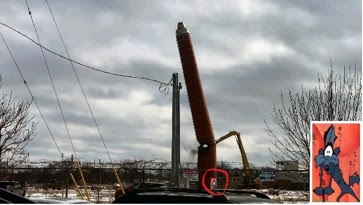
The SubStandard collected photos of the demolition caught by observers and submitted them to a forensic laboratory located in The City of Lincoln for more detailed analysis. As you will see, while the figure in question is almost imperceptible in the original picture, an enlargement reveals what appears to be a coyote detonating a charge capable of bringing down the beloved landmark.

While the SubStandard hesitates to risk spreading fake news, it appears that the smokestack was not knocked over by an errant crane but instead by a rogue coyote.

As shocking as it appears, this explanation would seem to explain the City’s inaction in prosecuting the demolition company originally believed to be responsible. The Ontario Criminal Code makes it extremely  difficult to sue a coyote. In addition, the SubStandard has learned that the coyote in question, anticipating possible charges, has engaged Acme Law and Explosives, one of the premier criminal law firms in the Niagara region, to head his defense team.  

St. Catharines to change name so people spell it right

ST. CATHARINES [sic] – The largest city in the Niagara peninsula has decided to change its name after realizing that the spelling of “St. Catharines” has been wrong for over two centuries.

“We’ve always insisted that our semi-literate Loyalist ancestors who named this city had it right,” explained Mayor Walter Sendzik. “We have always been adamant to correct those who would spell it “St. Catherine’s” or “St. Catharine’s”. However, after consulting with high school English teachers, we realized that we were the ones spelling it wrong this whole time.”

The city’s current moniker fails to meet current rules for both spelling and grammar. After an emergency city council meeting, the councillors and mayor moved to amend the name to “Saint Kathryn’s”.

“We decided to spell our name with a ‘K’ to give the city a new, modern look,” added the mayor. Locals along St. Paul Street were happy to hear that people from outside their fair city will now have a better chance of getting the name right.

“I wrote it as ‘St Kitts’ since I didn’t have the time to learn the proper misspelling,” explained resident Grace Allen. “But when I did that, my water bill kept being sent to the Caribbean Island, St. Kitts. I’m glad we put an end to the confusion.”

Saint Kathryn’s is not the first Canadian city or jurisdiction to change its name to comply with the rules of the English language. Before 1974, St. John’s, Newfoundland was spelled as “S’aint Jahnz” and ten years earlier, the Province of Saskatchewan was simply denoted as “X”.

This article was orgininally published by The Beaverton. You can find the original article here.

Councillor Finds New Toxin on GM Site!

As if lead, arsenic, copper, cadmium, barium, several kinds of PCBs and two dozen other pollutants weren’t enough, Councillor Karrie Porter has identified yet another contaminant. According to the councillor, “toxic masculinity” has polluted the GM brownfield site as well.
“While working to address issues on this property, there has been no end to misogyny, lies, opportunism and toxic masculinity, and I am not just talking about the owner,” Councillor Porter commented on her FB page.
We are deeply indebted to the councillor for pointing out this latest threat. Since no individuals infected with the condition were named, we are left to speculate as to whom Porter has diagnosed with this crippling malady. If you think you may suffer from toxic masculinity, we urge you to self-isolate and to always wear a mask, especially in mixed company.
In the meantime, we understand that scientists from the Ministry of Natural Resources are monitoring the fish population in 12 Mile Creek for an overabundance of chest hair.

PCB Pollution in 12 Mile Creek Only 908 Times over Provincial Guidelines!

Two new tests of pollution discharge from the old GM site into 12 Mile Creek have shown that PCBs originating on the site are flowing into the creek 365 days a year, rain, or shine. The measured discharge rate is only 908 times above what is stipulated by the provincial Water Quality Objectives.
Given this level, the Ministry of the Environment declared that these continuous leaks
pose absolutely no concerns to the health of neighborhood residents, and have no impacts to water quality in the creek- “If the rate of PCB discharge was 910 times or higher, we’d be concerned,” a ministry spokesperson told the SubStandard. The spokesperson said despite the benign nature of the steady flow of chemicals into the water supply, they have asked Bayshore, owner of the former factory site, to begin to generate a possible plan that at some future time might possibly stop some of the chemicals from leaching into the creek. “That’s what we’re here for,” the spokesperson emphasized. “To take the strong and decisive action needed to swiftly protect the environment and well-being of all the people of Ontario.”
PCBs are known to be a factor in melanoma, liver cancer, gall bladder cancer, biliary
tract cancer, gastrointestinal cancer, brain cancer and breast cancer. “Absolutely,” the ministry spokesperson agreed when the SubStandard pointed this out. “What’s your point?”

In the meantime, St. Catharines mayor Walter Sendzik reminded city council Monday night that the problems on 12 Mile Creek brought to council’s attention last month are only a small part of the world’s pollution problems today. “The goal is that everything should be cleaned up,” he said. “We shouldn’t narrow our focus to only one small part of the situation. Compared to the oil sands, or that big swirl of plastic in the Pacific Ocean, or, hey, exhausts from vehicles on the 401, 12 Mile Creek’s problems don’t amount to a hill of beans in this crazy world.” The health of St. Catharine’s residents is always his paramount concern, the mayor stressed. “I think it’s healthy we’re having this discussion. If you start feeling ill, just talk to somebody you know, or even a perfect stranger. A conversation is a healthy thing to do, and you’ll feel better fast.”